
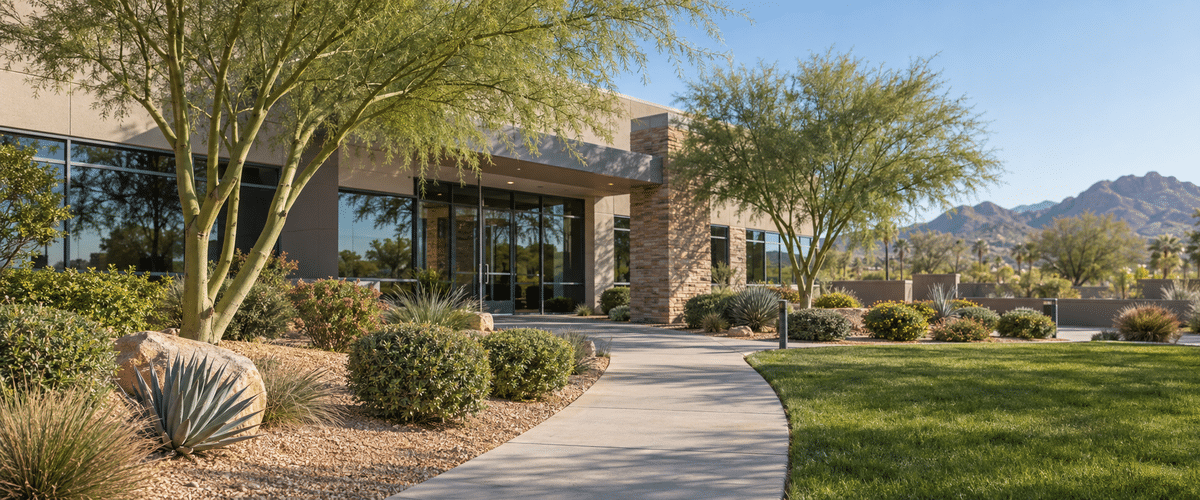
In Phoenix’s surrounding low desert, the average first frost doesn’t arrive until mid-November, and bermudagrass growth slows as October ends. Such timing means any shrub fertilization service property managers hire can’t follow the schedule of somewhere colder, where feeding stops before winter.
Even on a single commercial property, citrus, shrubs, and turf each have their own cutoff, so one application date can push tender growth into frost on some plants while leaving nutrient problems untreated in others.
Key Takeaways
- Shrubs should not be fertilized in late fall, and yellowing needs a diagnosis first because iron deficiency, zinc deficiency, and cold winter soils can all cause it.
- Citrus gets its last scheduled feeding by September.
- Overseeded turf follows a separate winter schedule that starts 30 days before overseeding, while non-overseeded bermudagrass stops after October.
- Over-fertilizing in fall can increase frost damage and disease, so stick to the rates Arizona Extension recommends.
- A soil test comes before the product, because fertilizer cannot correct compaction, grade changes, or irrigation problems.
Why Is Fall Fertilization Different in Phoenix?
Fall’s different in Phoenix because of the mild winters and the fact that growth gradually slows instead of stopping outright on a certain date. Three things explain the difference:
- Bermudagrass turns blonde only after frost for several continuous nights in November or December, and it does not actively resume growth until soil temperatures hold at 60 degrees Fahrenheit in April.
- Overseeded ryegrass stays green from October through May, so an overseeded lawn keeps growing through winter while a bermudagrass lawn beside it rests.
- Over-fertilizing can increase the likelihood of frost damage and disease.
Which Phoenix Shrubs and Trees Need Fall Fertilizer?
There aren’t many shrubs and trees in Phoenix that need fall fertilizer. Citrus gets its last scheduled feeding by September, and shrubs and other trees should be fed in fall only to correct a diagnosed deficiency like unavailable iron or low nitrogen.
Ornamental Shrubs
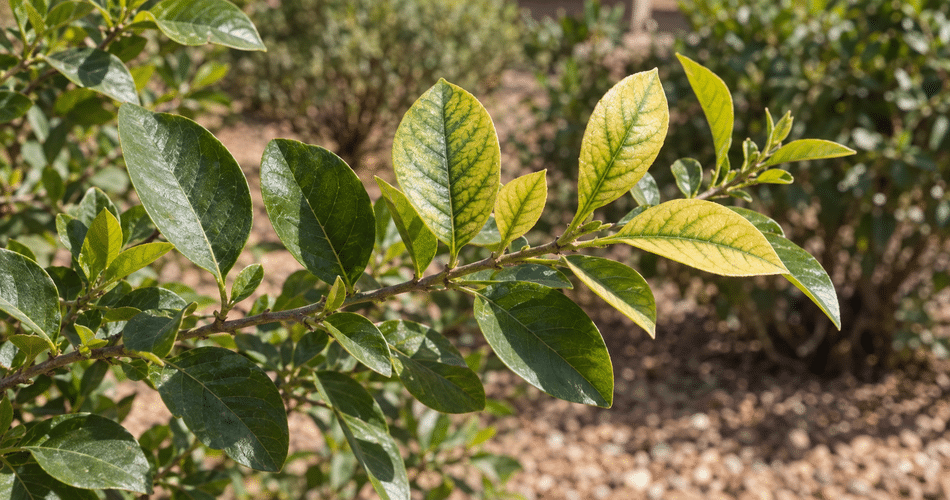
Yellowing between the veins can come from iron, zinc, or cold soil, so a diagnosis comes before any feeding.
Generally, desert-adapted shrubs don’t need fertilizer unless there’s a nutrient deficiency (which isn’t common). When a shrub does need feeding, the window is from early spring to late summer, just before or during a growth spurt. You should avoid feeding during late fall, since fertilizer stimulates tender growth that frost can damage. Feeding can also accelerate growth, which increases water use and pruning needs, so an unnecessary application adds nothing but cost.
In shrubs, iron deficiency shows up as:
- Pale yellow or white tissue between the leaf veins
- Symptoms on the youngest, newest leaves first
- Entirely white, stunted new leaves in severe cases
Desert soils usually have plenty of iron, but high pH makes it insoluble. Shrubs that originate in regions with acidic soils (e.g., roses, gardenia, and crepe myrtle) lack the ability to pull iron from high-pH ground and are most likely to show symptoms. To correct this, apply a chelated iron product to the soil or spray it on the leaves. Since a deficiency in zinc looks similar, a symptom by itself never confirms the cause.
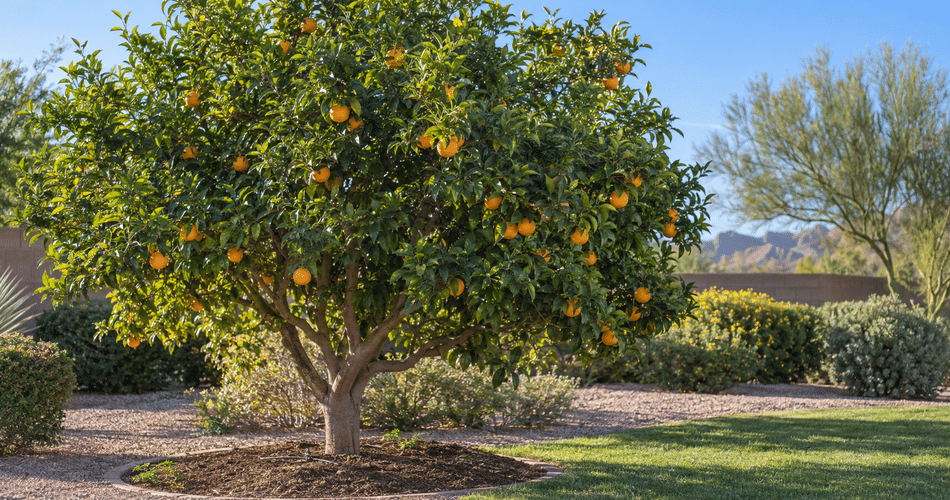
Citrus gets its last scheduled feeding by September, so fall is not a feeding season.
Citrus
Citrus has high nitrogen needs, so the Arizona citrus chart splits the annual dose into thirds on the following schedule:
- Oranges, tangerines, and grapefruit are fed in January-February, March-April, and May-June.
- Lemons and limes are fed in January-February, March-April, and August-September.
- No citrus type is scheduled for fertilizer after September.
Every application should be accurately measured, worked into the soil, and followed with irrigation so the nutrients get to the roots. If new leaves turn yellow, test the soil prior to adding more nitrogen.
Desert-Adapted Trees
Established palo verde and mesquite typically do well without fertilizer, and new ones don’t need it at planting (since extra nitrogen can slow root establishment). Iron deficiency is rare in these trees because they evolved in high-pH soils, so yellow leaves are worth a closer look, since the pattern tends to offer a clue. If the yellow starts on the older leaves, that points to nitrogen deficiency, while yellow leaves with green veins point to iron.
Extra feeding and watering have a couple of risks for these trees:
- Heavily fertilized and irrigated trees don’t tolerate cold as well as trees conditioned with less water and no fertilizer late in summer.
- Mesquites can become unstable with excess irrigation, such as in lawns, because rapid crown growth outpaces limited root development, and fertilizer encourages the same rapid growth.
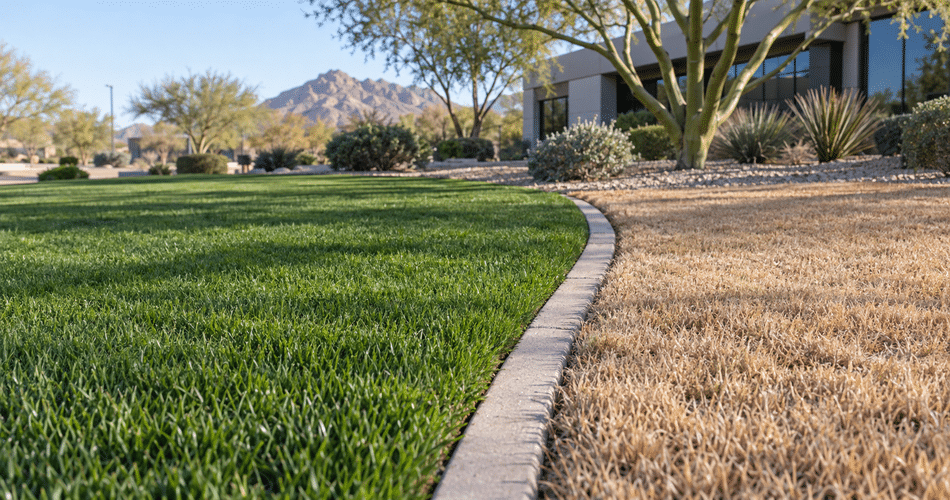
Overseeded ryegrass stays green through winter while bermudagrass beside it rests.
Should You Fertilize Turf in the Fall?
Yes, but it depends on whether the lawn is overseeded with winter ryegrass. Non-overseeded bermudagrass gets half a pound of nitrogen per 1,000 square feet every month through October, then rests until spring and stays off-color for a few months. Overseeded turf switches to a winter schedule, and the order of the steps matters:
- Stop nitrogen on the bermudagrass 30 days before overseeding.
- Overseed between October 10 and November 10 in Phoenix, with October ideal when daytime highs are 80 to 85 degrees.
- Use a higher-phosphate product the month after overseeding, such as ammonium phosphate (16-20-0) at 5 pounds per 1,000 square feet about two weeks after seedlings emerge.
Whichever schedule applies, always water after applying fertilizer. On commercial properties, we scalp high-visibility lawns at HOAs and apartment communities, then overseed them with perennial ryegrass at 12 to 15 pounds per 1,000 square feet and water three to four times a day until germination, which can take anywhere from 7 to 10 days. The ryegrass has to germinate while the weather’s still warm, which is through about mid-November, or the window closes until spring.
What Does a Good Fall Fertilization Program Include?
A good fall fertilization program tests the soil, matches product and timing to each species, and documents what was applied. There’s a specific order to the steps, too:
- Test the Soil: A lab analysis reports soil pH, calcium carbonate levels, and plant-available iron, which a calendar cannot supply. Our soil testing and amendments service covers this step.
- Check the Site: Fertilizer cannot correct compaction, a grade change, or an irrigation problem.
- Match Plan to Each Species: Product, timing, and rate should fit the plant, because different species run on different schedules.
- Keep Gypsum Separate: We apply it right after aeration through our aeration-and-gypsum service, which is summer work.
- Document Every Application: Record the date, product, and area so next season starts from facts.
When to Bring in a Professional
It’d be smart to bring in a professional when symptoms are widespread, persist after a correction, or may have a cause that isn’t nutrition-related. Because vulnerability varies a lot between plants (a severely affected plant can grow beside a symptom-free one in identical soil), one plant’s symptoms hardly ever justify treating an entire property.
When iron is a part of the plan, read the product label to confirm that all of the iron is chelated, since some labels list only a small amount. Ask any vendor the following questions before approving a plan:
- Whether they soil test first
- Whether the plan is species-specific
- Timing cutoffs by plant
- Whether applications are timed ahead of irrigation so the nutrients reach the roots
- How each application is documented
Frequently Asked Questions About Fall Fertilization
Can you lower the pH of Phoenix soil?
Rarely in the ground. Most desert soils have a pH of about 8.0 to 8.5, and desert soils with caliche are very well buffered, so the change rarely lasts. Acidifying is most likely to work in containers or small beds where plants are replaced often.
Can cold weather cause yellow leaves even when the soil has enough iron?
Yes. Cold winter soils can induce iron deficiency, and the yellowing often disappears when soils warm in spring, so watch winter yellowing before adding product.
How much fertilizer does a mature citrus tree need each year?
A large orange or tangerine tree, 10 feet or taller, needs about 1.25 to 1.50 pounds of actual nitrogen per year. Grapefruit and pummelo trees need half that amount, and lemons and limes about 10 percent more. The percent nitrogen on the bag determines how many pounds of product that equals.
Should a new bermudagrass lawn be overseeded its first winter?
No. The usual recommendation is to wait, because regrowing in spring while competing with vigorous winter grass is very stressful for a newly planted bermudagrass lawn.
How much water does winter turf need?
It depends on the turf type. Overseeded winter turf may need 1/2 to 1-1/2 inches of water per week between November and May, depending on soil, temperature, and rainfall. Non-overseeded bermudagrass that has gone blonde generally needs no supplemental irrigation, and if winter rains are lacking, running the system once a month from December through February keeps the roots moist.
Have Titan Landscape Services Handle Your Fall Fertilization Plan
If you manage a commercial property in the Phoenix area, we can evaluate your trees, shrubs, and turf, and recommend a plan through our fertilization services. Request a free property evaluation today to get started!
